
China Top 10 IP LCD Display Manufacturers?
China’s IP LCD Display industry has grown beyond simple screen manufacturing. Today, suppliers combine LCD panels, network control, protective housing, software, and after-sales service. This article introduces ten Chinese manufacturers that deserve closer evaluation, not automatic praise.
A strong supplier should provide more than a bright panel. It should show stable network performance, accurate color reproduction, clear product documentation, and dependable production records. Outdoor projects also require careful attention to dust protection, operating temperature, sunlight readability, and remote maintenance. Small details matter. A loose connector can stop an entire display system.
Display analyst Ross Young has emphasized, “The display industry is cyclical.” That warning remains useful when comparing Chinese manufacturers. Market demand, panel pricing, component shortages, and technology changes can quickly affect delivery and cost. Therefore, this guide considers manufacturing experience, product consistency, customization ability, quality certifications, technical support, and export capability.
The ranking is not absolute. No ranking is perfect. A large factory may offer impressive capacity but weaker communication. A smaller specialist may deliver better customization but face limited resources. Buyers should verify samples, factory processes, warranty terms, and integration support before signing contracts. This article focuses on practical evidence rather than promotional claims, helping distributors, system integrators, and project owners identify suitable IP LCD Display partners in China. Some conclusions may change as technologies and supplier strategies develop. That uncertainty deserves attention, too.
What Is an IP LCD Display and How Is It Used?
An IP LCD display is an LCD screen designed to resist dust, water, or both. Here, “IP” means Ingress Protection, not Internet Protocol. The rating usually has two numbers. The first measures protection from solid particles, while the second measures water resistance. For example, an IP65 display is dust-tight and protected against water jets. It is not designed for underwater operation.
These displays support outdoor kiosks, factory control panels, medical equipment, transport systems, and marine instruments. A bright screen may remain readable beside a loading dock, even under direct sunlight. Sealed bezels reduce contamination around the panel. However, sealing can trap heat. That detail is often overlooked.
When comparing manufacturers in China, buyers should request test reports, operating temperature data, gasket materials, and touch-panel specifications. IEC 60529 testing gives the IP rating a reliable reference, but installation still matters.
Cable glands, mounting pressure, and cabinet design can weaken protection. A display with a high rating may fail if its connectors face upward during heavy rain.
Optical bonding can improve visibility and reduce internal reflections, though it may increase service costs. I would also check long-term brightness retention, response time, viewing angle, and replacement availability. Specifications look precise. Real environments are less predictable.
Why China Has Become a Major IP LCD Display Manufacturing Hub
China Top 10 IP LCD Display Manufacturers?
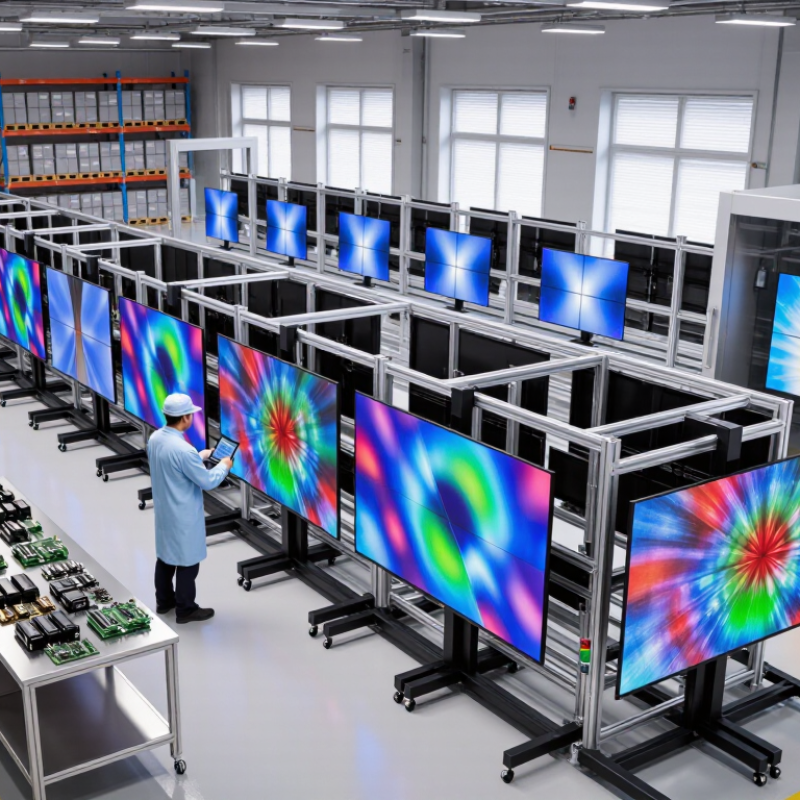
China has become a major IP LCD display manufacturing hub through dense industrial coordination. Glass, touch panels, backlights, controllers, metal frames, and sealing materials are often produced within connected regional supply chains. This proximity reduces shipping delays and simplifies technical communication. Engineers can inspect a prototype in the morning and adjust its enclosure by afternoon. That speed matters when displays must fit kiosks, factory equipment, vehicles, or outdoor control panels.
Manufacturers also offer strong customization capabilities. Buyers can request sunlight-readable panels, glove-friendly touchscreens, wide-temperature operation, or reinforced front surfaces. IP protection requires careful sealing around buttons, connectors, and mounting edges. Small design gaps can allow moisture or dust to enter. Testing may include water exposure, vibration checks, thermal cycling, and repeated touch operation. Practical experience is important here, because laboratory results do not always reflect field conditions.
The wider export network supports global delivery and replacement planning. Documentation, sample approval, and production tracking have become more structured across many factories. Still, the picture is not perfect. Low prices can hide weaker testing, inconsistent components, or limited after-sales support. A responsible buyer should review inspection records, verify ratings independently, and test samples under realistic conditions. Certification alone is not enough. Supplier reliability needs evidence over time.
Selection Criteria for Ranking China’s Top 10 IP LCD Display Manufacturers
Ranking China’s top 10 IP LCD display manufacturers requires more than comparing catalog prices. The selection should begin with verified ingress protection performance. We examine test reports, enclosure design, gasket quality, connector sealing, and production consistency. A claimed IP65 rating means little if the sample fails after cleaning or vibration. Practical experience matters here. Displays should survive dust, water spray, temperature changes, and daily operator contact.
Technical capability carries the greatest weight. We assess sunlight readability, touch response through gloves, viewing angle, brightness control, and operation across the stated temperature range. We also review glass bonding, anti-glare treatment, cable options, and mounting accuracy. Reliable manufacturers explain limits clearly instead of promising every feature. That honesty is useful. Evidence from pilot projects, factory audits, and batch records supports the ranking. Quality systems, traceability, and corrective-action procedures reveal manufacturing maturity.
Commercial reliability completes the evaluation. We compare sample lead times, engineering communication, customization control, spare-parts planning, and after-sales response. Export experience matters, but documented compliance with applicable safety and electromagnetic requirements matters more. Price remains relevant, though it cannot replace stable brightness or a sealed housing. No ranking is perfect. Test conditions differ, and public evidence may be incomplete. A second audit may still change the order.
Profiles of China’s Top 10 IP LCD Display Manufacturers
China’s top 10 IP LCD display manufacturers show different strengths in rugged visual technology. Some focus on sealed industrial monitors for factories, control rooms, and outdoor kiosks. Others develop sunlight-readable panels with high brightness, optical bonding, and wide-temperature performance. Their products commonly use aluminum housings, corrosion-resistant coatings, and protection ratings suited to dust and water exposure.
Several manufacturers specialize in custom engineering. They adjust screen sizes, touch interfaces, connector positions, and mounting structures for equipment makers. One profile stands out for medical-grade design, including cleanable surfaces and stable color reproduction. Another concentrates on transportation displays, where vibration resistance and anti-glare glass matter. A smaller supplier may offer faster prototypes, but its testing records can be less complete. That deserves careful review.
Experience becomes visible in practical details. Reliable factories document temperature cycling, humidity testing, impact resistance, and touch durability. They also provide traceable quality checks before shipment. Some maintain automated assembly lines, while others rely more heavily on skilled manual inspection. Neither approach guarantees consistent performance. Buyers should examine sample reports, warranty terms, firmware support, and long-term parts availability. In my view, the strongest profiles combine engineering depth with honest communication about limits. IP protection alone does not solve poor viewing angles, weak brightness, or difficult installation. Small details matter.
How to Choose the Right Chinese IP LCD Display Manufacturer
China Top 10 IP LCD Display Manufacturers?
How to Choose the Right Chinese IP LCD Display Manufacturer
Choosing among China’s leading IP LCD display manufacturers requires more than comparing online rankings. Check the factory’s experience with your environment, not only its product catalog. A marine console needs different protection from a warehouse terminal. Ask for IP test reports, operating temperature data, and sunlight readability results. Confirm whether the enclosure, sealing, bonding, and touch panel are produced under one quality system. During supplier visits, inspect clean assembly areas, aging-test equipment, and serial-number traceability. These details reveal practical manufacturing discipline.
Tips: Request three samples. Test them in real conditions. Check brightness after several hours. Measure touch response with gloves. Review failure records, not only success stories. Confirm the warranty process and spare-parts policy. A low quotation may exclude tooling, packaging, or testing. Clarify every cost before signing.
A reliable manufacturer should provide clear drawings, tolerance data, and inspection standards. Discuss glass thickness, connector position, cable length, and mounting holes early. Ask how design changes are approved and recorded. Small communication gaps can create expensive production errors. I have seen attractive samples fail when heat, vibration, or moisture increased. No factory is perfect. The better partner admits weaknesses and proposes measurable corrections. Before mass production, use a pilot batch and inspect every display against agreed criteria. Supplier selection should reflect evidence, communication, and repeatable performance, rather than impressive promises.
| Rank | Anonymized Manufacturer | Primary Manufacturing Region | Typical Product Range | Common IP Protection | Display Technology | Operating Temperature | Customization Capability | Typical Certifications | Typical MOQ | Typical Lead Time | Warranty | Best-Fit Applications | Selection Score |
|---|---|---|---|---|---|---|---|---|---|---|---|---|---|
| 1 | Manufacturer A High-volume industrial display specialist | Shenzhen, Guangdong | 7–32 inches | IP65IP67 option | TFT LCD, IPS, high-brightness LCD | -20°C to +70°C | Custom cover glass, touch panel, housing, cables and firmware | CE, FCC, RoHS | 50 units | 4–6 weeks after approval | 12–24 months | Factory automation, outdoor control panels, HMI systems | ★★★★★ 9.4/10 |
| 2 | Manufacturer B Rugged embedded display supplier | Dongguan, Guangdong | 4.3–21.5 inches | IP54IP65 | TFT LCD, projected capacitive touch | -30°C to +80°C | Optical bonding, anti-glare coating, custom bezel and connector layout | CE, FCC, RoHS, REACH | 100 units | 5–8 weeks after approval | 12 months | Medical equipment, transportation, industrial instruments | ★★★★★ 9.1/10 |
| 3 | Manufacturer C Outdoor-readable LCD producer | Shenzhen, Guangdong | 10.1–55 inches | IP65IP66 option | High-brightness TFT LCD, sunlight-readable LCD | -20°C to +65°C | 1,000–3,000 nit brightness, thermal design, sunlight-readable glass | CE, FCC, RoHS | 30 units | 6–9 weeks after approval | 12 months | Outdoor kiosks, marine equipment, parking systems, digital signage | ★★★★☆ 8.9/10 |
| 4 | Manufacturer D Small and medium-size HMI display supplier | Huizhou, Guangdong | 3.5–15.6 inches | IP54IP65 option | TFT LCD, IPS, resistive touch | -20°C to +70°C | Custom PCAP, resistive touch, FPC, logo-free front panels and mounting | CE, FCC, RoHS | 100 units | 4–7 weeks after approval | 12 months | Laboratory instruments, smart meters, control terminals | ★★★★☆ 8.7/10 |
| 5 | Manufacturer E Custom panel PC and monitor manufacturer | Shanghai, China | 10.4–23.8 inches | IP65 frontIP54 enclosure | Industrial TFT LCD, touch monitor, panel PC | -10°C to +60°C | Panel PC integration, CPU selection, I/O customization and mechanical design | CE, FCC, RoHS, UL-related options | 20 units | 6–10 weeks after approval | 12–24 months | Industrial automation, logistics, self-service terminals | ★★★★☆ 8.6/10 |
| 6 | Manufacturer F Cost-effective LCD module supplier | Shenzhen, Guangdong | 2.8–12.1 inches | IP54IP65 option | TFT LCD, monochrome LCD, standard touch modules | -20°C to +70°C | Custom FPC, backlight, touch interface and connector arrangement | CE, FCC, RoHS | 200 units | 4–8 weeks after approval | 12 months | Consumer electronics, measuring devices, compact control systems | ★★★★☆ 8.3/10 |
| 7 | Manufacturer G Transportation display specialist | Suzhou, Jiangsu | 7–19 inches | IP65IP67 option | High-reliability TFT LCD, wide-temperature LCD | -30°C to +85°C | Vibration-resistant housing, anti-reflective glass, custom power input | CE, FCC, RoHS, ISO 9001 production systems | 50 units | 8–12 weeks after approval | 12–24 months | Railway equipment, buses, fleet terminals and marine controls | ★★★★☆ 8.2/10 |
| 8 | Manufacturer H Touch-display integration manufacturer | Xiamen, Fujian | 5–27 inches | IP54IP65 front | IPS LCD, PCAP touch, bonded display assemblies | -20°C to +70°C | Optical bonding, anti-fingerprint coating, custom touch sensitivity and glass | CE, FCC, RoHS, REACH | 100 units | 5–9 weeks after approval | 12 months | Retail terminals, digital healthcare, access control systems | ★★★★☆ 8.0/10 |
| 9 | Manufacturer I OEM/ODM display assembly supplier | Ningbo, Zhejiang | 7–32 inches | IP54IP65 option | TFT LCD, LED-backlit LCD, touch monitor | -10°C to +60°C | Mechanical enclosure, cable assemblies, front-panel printing and packaging | CE, FCC, RoHS | 50 units | 6–10 weeks after approval | 12 months | Commercial equipment, vending machines, POS and information terminals | ★★★☆☆ 7.8/10 |
| 10 | Manufacturer J Prototype and low-volume display partner | Wuhan, Hubei | 3.5–21.5 inches | IP54IP65 custom | TFT LCD, IPS LCD, custom touch display | -20°C to +70°C | Rapid prototyping, custom firmware, touch integration and small-batch assembly | CE, FCC, RoHS | 10 units | 3–6 weeks for prototypes | 12 months | R&D projects, proof-of-concept units and specialized equipment | ★★★☆☆ 7.6/10 |