Why Is Laboratory Robotics Important for Global Buyers?

Laboratory robotics is changing how global buyers evaluate speed, accuracy, and operational resilience. It is no longer limited to futuristic research centers. Today, automated liquid handlers, robotic arms, plate readers, and sample transport systems support pharmaceutical, clinical, academic, and industrial laboratories. A technician can load a 96-well plate, define a validated method, and monitor each transfer through software records. Small movements matter. A missed microliter can distort an entire experiment.

Joseph F. Engelberger, widely recognized as a pioneer of industrial robotics, said, “The key to successful automation is having the right balance between human and machine.” This principle remains valuable for laboratory robotics procurement. Buyers should assess more than instrument speed. They need to examine pipetting precision, software compatibility, data traceability, cleaning procedures, operator training, and regional service support. A system that performs well in a demonstration may struggle with local workflows, unstable network access, or limited technical support. That gap is often overlooked.

Global purchasing also requires careful attention to validation, cybersecurity, maintenance, and integration standards. Reliable suppliers provide documented performance data, realistic installation timelines, and transparent ownership costs. They explain limitations instead of promising perfection. That honesty matters.

Automation is not effortless.

Laboratory robotics can reduce repetitive handling, improve consistency, and protect staff from unnecessary exposure. However, it cannot replace sound experimental design or responsible oversight. Buyers must match robotic capability with actual sample volumes, staff expertise, and future growth. The best investment is not always the fastest machine. Sometimes, a simpler platform delivers greater reliability, easier training, and better long-term value. Manufacturers and buyers should keep reviewing these choices, because laboratory needs change faster than procurement plans.
Why Is Laboratory Robotics Important for Global Buyers?

What Is Laboratory Robotics and How Does It Work?

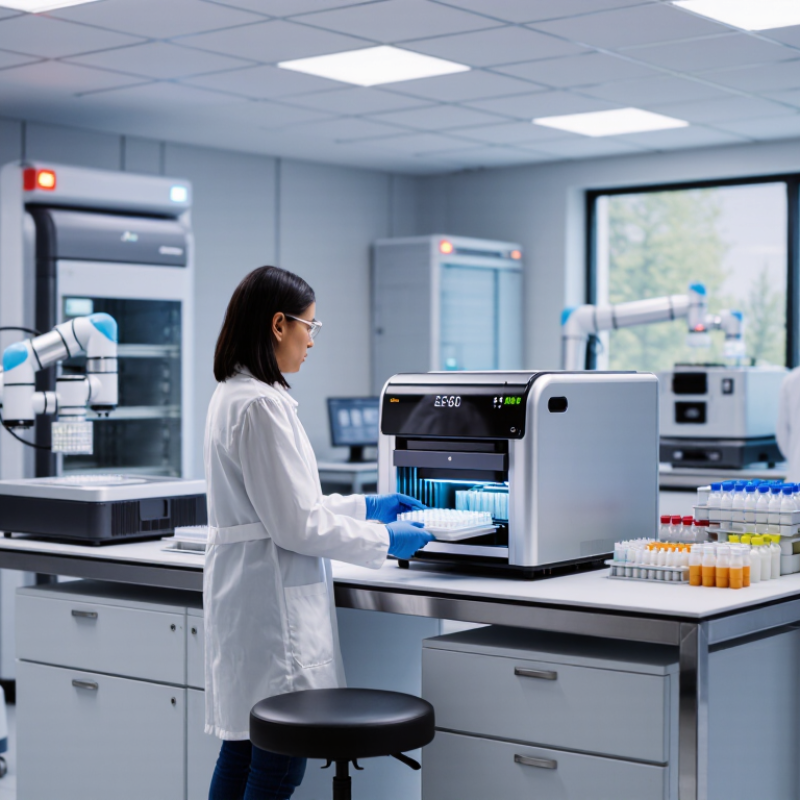
Laboratory robotics combines mechanical arms, liquid handlers, sensors, and software to move samples through repeatable workflows. A typical system scans a barcode, picks a tube, dispenses precise volumes, and transfers it to an incubator or analyzer. The orchestration software records each action and can connect with a laboratory information management system.

That matters.

According to MarketsandMarkets’ Laboratory Automation Market report, the sector is projected to grow from about USD 5.7 billion in 2023 to USD 8.4 billion by 2028. The report links this growth to rising testing volumes and demand for consistent results.

The International Federation of Robotics also reported 553,052 industrial robots installed worldwide in 2022, showing how automation is becoming normal across technical industries. Laboratory robotics applies that trend to smaller, more sensitive tasks.

For global buyers, the real value is not simply faster motion. A robotic workstation can reduce repetitive pipetting, limit direct contact with biological samples, and create digital records for quality review. Buyers should examine accuracy, throughput, cleaning procedures, software compatibility, and local service capacity. ISO/IEC 17025 principles also make traceability and validated processes important for testing laboratories.

Yet automation is not magic. Poor calibration, unsuitable labware, or weak data integration can create systematic errors at impressive speed. Some workflows still require skilled judgment, especially when samples behave unpredictably. The honest assessment is often less exciting: robotics improves controlled repetition, but it does not replace method design or careful human review.

Why Laboratory Robotics Matters to Global Buyers

Laboratory robotics matters to global buyers because it connects daily laboratory work with consistent, measurable performance. A robotic system can move samples, prepare plates, and record results with fewer repetitive errors. In a busy laboratory, this may mean steadier workflows during long shifts. It can also reduce exposure to routine handling risks. Small gains matter.

Global buyers need more than impressive automation. They must examine compatibility with existing instruments, software, sample containers, and data systems. A system that works well in one facility may require costly changes elsewhere. Local voltage, language support, technical training, and service coverage also affect real performance. Procurement teams should request documented specifications, validation procedures, maintenance schedules, and realistic implementation timelines.

Laboratory robotics can improve traceability because each action may be logged with time, operator, and sample details. This supports quality management and internal audits. However, automation does not remove the need for trained professionals. Staff still need to review exceptions, confirm results, and respond to equipment failures. That part is sometimes underestimated. A failed gripper or unclear barcode can stop an entire workflow.

Global purchasing decisions should consider total ownership costs, not only the initial quotation. Consumables, calibration, software updates, spare parts, and downtime can change the financial picture. Buyers should test representative samples before signing a large contract. A careful pilot may reveal awkward workflows that a polished demonstration hides. Human judgment remains essential.

Why Is Laboratory Robotics Important for Global Buyers?

Higher research intensity increases the need for scalable, reproducible, and data-driven laboratory workflows. Laboratory robotics helps global buyers improve throughput, reduce manual variability, and support consistent operations across sites.

R&D expenditure as a percentage of GDP, selected economies, 2022. Values are rounded and based on the World Bank indicator “Research and development expenditure (% of GDP)” compiled from UNESCO Institute for Statistics and OECD data.

Which Laboratory Tasks Can Robotics Improve?

Laboratory robotics matters because it changes routine work into controlled, traceable workflows. According to Grand View Research’s 2024 Laboratory Automation Market report, the market could grow at a 5.8% CAGR through 2030. That growth reflects demand for faster testing, tighter reproducibility, and fewer avoidable handling errors. Small errors matter. Global buyers should examine tasks, not simply purchase robot arms.

Robots can pipette samples, cap tubes, label vessels, and transfer plates between instruments. They can also prepare serial dilutions, mix reagents, wash microplates, and load centrifuges. In high-throughput screening, software records timestamps, volumes, and sample identities automatically. The International Federation of Robotics reported a 30% rise in professional service robot sales during 2023, reaching about 205,000 units. That figure covers multiple sectors, but it signals stronger automation demand. Repetition is exhausting.

Yet automation does not repair poor protocols. It may repeat a flawed method perfectly, which remains a flawed result. Robotics improves weighing, imaging, sorting, inventory checks, and temperature monitoring when sensors are validated. It can reduce direct contact with irritants and cold-storage materials during routine operations. Buyers need open data formats, cleanable surfaces, calibration records, and regional service coverage. I would not promise zero errors; unusual samples and clogged tips still require trained human judgment.

What Should Global Buyers Evaluate Before Purchasing?

Why Is Laboratory Robotics Important for Global Buyers?

Global buyers should evaluate laboratory robotics as a workflow investment, not a standalone machine. MarketsandMarkets estimates the laboratory automation market could grow from about USD 5.1 billion in 2023 to USD 8.4 billion by 2028. That growth reflects rising pressure for speed, repeatability, and labor efficiency. Fit matters. A robot that cannot handle local sample tubes, viscous liquids, or changing protocols may create expensive delays.

Before purchasing, buyers should test throughput under real conditions. Ask for evidence on pipetting precision, contamination control, uptime, and recovery after errors. The system should connect with laboratory information systems and support common data standards. Interoperability reduces manual transcription, but it is often treated as an afterthought. Data matters. The FDA’s 2024 report on AI-enabled medical devices also highlights the importance of data quality, validation, and lifecycle monitoring, principles relevant to automated laboratories.

Service capability deserves equal attention. Review installation training, spare-part availability, remote support, cybersecurity controls, and response times across target regions. Grand View Research reported continued expansion in laboratory automation through 2030, driven partly by pharmaceutical and diagnostic demand. Yet market growth does not guarantee a suitable purchase. Buyers should calculate total ownership costs, including consumables, software updates, calibration, and downtime. I would also request a site trial. Brochures rarely show awkward samples, limited bench space, or tired operators at the end of a long shift. Some uncertainty remains, and honest evaluation should expose it before contracts are signed.

Why Is Laboratory Robotics Important for Global Buyers? - What Should Global Buyers Evaluate Before Purchasing?

Evaluation Dimension Why It Matters to Global Buyers Measurable Data or Target What to Verify Before Purchase Recommended Priority
Throughput and Capacity Automation must support current workload while allowing for future sample growth and peak demand. Define required samples per hour, daily sample volume, batch size, and maximum queue time. Use a 20–30% capacity reserve for growth. Request a site-specific performance test using the buyer’s actual containers, sample types, and workflow. High
Pipetting Accuracy and Precision Liquid-handling errors can affect test validity, reagent consumption, repeat testing, and operating cost. Evaluate manufacturer-stated systematic error and random error across the full intended volume range. For quantitative assays, set an acceptance limit such as CV ≤5% where scientifically appropriate. Review gravimetric or analytical verification data, minimum dispensing volume, liquid-class settings, and performance with viscous or volatile liquids. Critical
Contamination Control Carryover and aerosol contamination can create false-positive results and compromise entire batches. Set a validated carryover limit appropriate to the assay, use disposable or washable tips as required, and define decontamination frequency and materials. Check deck zoning, tip-change logic, liquid-level sensing, splash protection, UV or chemical decontamination options, and carryover test protocols. Critical
Integration and Interoperability Global laboratories often operate instruments, software, and information systems from multiple suppliers. Confirm supported communication methods, file formats, application programming interfaces, barcode standards, and laboratory information system connectivity. Ask for an integration architecture, interface documentation, data-mapping examples, and a demonstration using the existing laboratory information system. High
Traceability and Data Integrity Complete records are essential for result review, investigations, audits, and regulated laboratory operations. The system should record user identity, timestamps, sample movements, reagent lots, method versions, alarms, edits, and electronic approvals in an audit trail. Evaluate audit-trail controls, role-based permissions, backup and restoration procedures, time synchronization, and electronic-record functionality where applicable. Critical
Reliability and Availability Unplanned downtime can delay results, increase manual work, and disrupt time-sensitive testing. Set an availability target, commonly at least 95% for routine production environments, while separately tracking mean time between failures and mean time to repair. Request service-history data from comparable installations, preventive-maintenance intervals, spare-parts availability, and remote-support procedures. High
Validation and Regulatory Readiness Laboratories may need documented evidence that automated processes are fit for their intended use and controlled throughout their lifecycle. Plan documented installation qualification, operational qualification, and performance qualification. Requirements may also include ISO/IEC 17025, ISO 15189, quality-system controls, or electronic-record regulations. Confirm availability of qualification templates, risk assessments, software-version records, change-control procedures, and technical documentation. Critical
Flexibility and Scalability Testing menus, sample formats, and process requirements can change across countries and over time. Assess the number of deck positions, compatible labware formats, configurable workflows, additional instrument connections, and upgrade paths. Test at least three representative workflows, including a standard process, a high-volume process, and an exception or rework process. High
Total Cost of Ownership The purchase price is only one part of the long-term financial impact of laboratory automation. Calculate equipment, installation, validation, software, service contracts, consumables, training, utilities, downtime, and disposal costs over a defined period, such as five years. Compare cost per processed sample and payback under low, expected, and peak utilization scenarios. High
International Service and Supply Support Local support capability affects installation time, training quality, repair speed, and continuity of operation. Evaluate response-time commitments, local technician coverage, language support, critical spare-parts lead time, and training availability. Review service-level agreements, escalation procedures, warranty scope, export documentation, customs responsibilities, and regional inventory arrangements. High
Operator Safety and Usability Safe, intuitive systems reduce training burden, procedural deviations, and dependence on a small number of specialists. Assess guarding, interlocks, emergency-stop functions, ergonomic reach, alarm clarity, user access levels, and routine task duration. Conduct a usability trial with representative operators and document required training time, error recovery steps, and cleaning procedures. Medium to High

Note: Performance targets are procurement benchmarks rather than universal regulatory limits. Final acceptance criteria should be defined through a documented risk assessment, intended-use analysis, and validation plan for the specific laboratory workflow.

How Will Laboratory Robotics Shape Future Research?

Laboratory robotics will reshape research by turning repetitive handling into a controlled, traceable workflow.

A robotic arm can move microplates, add reagents, scan barcodes, and record timestamps without tiring. This matters when experiments run overnight or require thousands of nearly identical steps. The process becomes more consistent.

Market evidence supports this shift, although estimates differ. Grand View Research valued the global laboratory automation market at approximately USD 5.17 billion in 2023. MarketsandMarkets projected growth from about USD 5.3 billion in 2023 to USD 8.3 billion by 2028. These reports use different market definitions, so the figures should not be treated as exact measurements of robotics alone. Still, the direction is clear.

Future systems will connect instruments, scheduling software, data capture, and machine learning. Researchers could compare results across sites more reliably. Smaller laboratories may also access high-throughput methods without expanding every manual task.

That promise is not automatic. Poorly calibrated pipetting, unclear maintenance records, or weak data standards can multiply errors at machine speed. I would not remove scientists from the process. Their role should move toward experimental design, anomaly review, and ethical decisions.

The International Federation of Robotics reported 553,052 industrial robots installed worldwide in 2022, showing how quickly automation infrastructure is expanding beyond traditional factories. Laboratory adoption will likely be slower and more cautious. That may be healthier.

Research needs speed, but it also needs questions that machines cannot yet recognize.

Scroll to Top